

Sharon Williams, February 2024 Issue of the Clinton Historical Society Newsletter
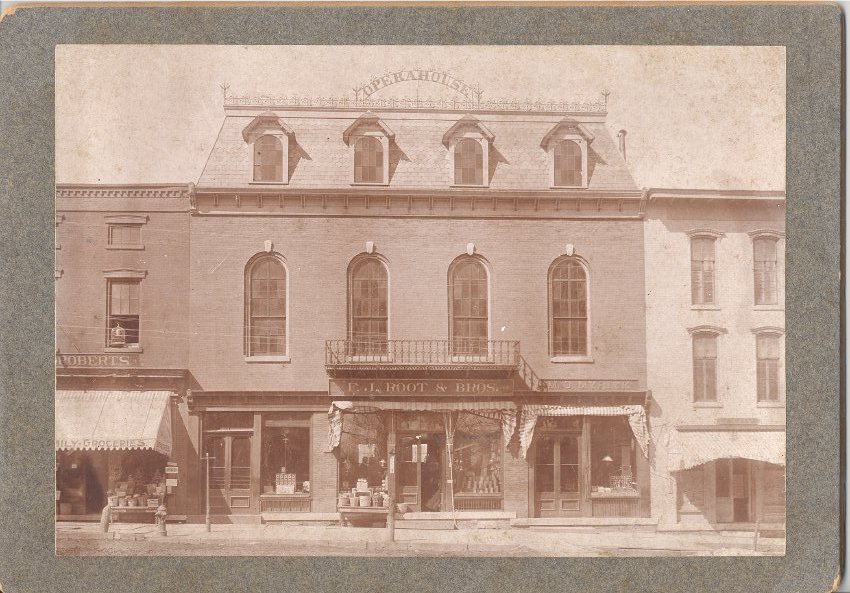
Have you ever wondered how Clintonians of the past found ways to entertain themselves during long winter months? From the 1860s to the 1930s, a major source for community events and entertainment was the Scollard Opera House on West Park Row, located in the building once occupied by the Clinton Shoe Center.
The opera house took up the second floor of a building erected in 1868 by Clinton postmaster John Tower on a lot made vacant in 1862 by a devastating West Park Row fire. In the Historical Society’s November 1972 newsletter, editor Phil Munson wrote that the new Tower block was then purchased in 1876 by Dr. James Scollard, a local physician, and the second floor public hall quickly became known as the Scollard Opera House. In 1885 new features were added to the building, including large stained-glass windows and a dormer-windowed, mansard roof, topped with ornamental ironwork spelling out “Opera House.” The entrance was through the double doors on the left side of the building. The outside appearance of the opera house and the surrounding first-floor shops remained unchanged until 1958, when the dormers and ironwork were removed.
From the 1860s to the 1930s, the Scollard’s gas-lit stage truly was the social center of Clinton. But first, a clarification: a typical 19th-century small-town “opera house” such as the Scollard never offered high-brow classical performances. Far from it. Rather, a small-town opera house offered a crazy mix of events and entertainment. The Scollard was the scene of important civic events such as annual village meetings and elections. It was the place for CCS functions, including graduation exercises, public-speaking contests, and basketball games. The volunteer firemen raised funds by offering fairs with games of chance. Local social organizations such as the Excelsior Hose Company and the Skenandoa
Club held fancy balls and dinners. Amateur theater groups performed, including the Hamilton College Glee Club and the Mandolin and Banjo Society. Semiprofessional traveling theater groups and minstrel shows brought a mix of music and drama, including the very popular Uncle Tom’s Cabin and lectures were offered with accompanying magic lantern slides. In the newsletter for November 1971, Munson described a 1897 traveling show that featured “an evening of fun by a female bird whistler, a harpist, and an impersonator.” (Fun!) When Nature’s Remedy Company of Philadelphia set up for two weeks, it offered high class acts, sales of bottles of “Nature’s Remedy,” and, the following
day, tooth extractions.
The Scollard also was the place where the small village of Clinton connected to the larger world. The attached image shows the program for a 1922 Russian Relief Benefit, prompted by an International Red Cross drive to raise funds for victims of the devastating famine that followed the 1918−1921 Russian civil war. The benefit program was eclectic, including a Russian Cossack dance, an Irish Jig, a Mexican Fan Dance, and vocal solos; Clintonians’ hearts truly were in the right place.
Studying the advertising in programs for Scollard performances adds to our understanding of 19th-century life in Clinton. For example, a program in the CHS collections features the February 5, 1898, performance of Charley’s Aunt, a late 19th-century British farce. Advertisements in the program show the types of commercial establishments in the village and include names that are familiar today. Village businesses in 1898 included Allen’s bicycles, Burdick’s Fine Shoes, the Root Drug and Grocery Store, the Burns Grocery, Stebbins Wallpaper, Dawes Boots and Shoes, and Hogan’s Corner Store. Not only could you outfit yourself and feed the family at these establishments, you also could redden your complexion with a Clinton Metallic Paint Co. product and order coal from Mr. C. H. Smyth. All without leaving the village!
Starting around 1910, silent movies, with the all-important piano accompaniment, became a regular offering at the Scollard. Munson, in the November 1972 newsletter, provides entertaining details about Clinton’s silent movie era. In 1913 owner E. G. Varney advertised that he would provide “the ‘best of photoplays’ on Saturday evenings, adults 15 cents, children 10 cents, reserve seat 5 cents extra.” Toward the end of the Scollard years, “talking” pictures arrived, although they were silent because the Scollard lacked the necessary sound equipment. In the January 1973 newsletter, Munson describes that two high schoolers were hired to improvise sound to accompany the 1929 hit film Wings starring Gary Cooper. For the air combat scenes, they used drums, electric fans, and “other gadgets to give a rousing rendition of airplane engines, machine guns, and crashes.”
The early decades of the 20th century brought the end of the Scollard. The building needed renovation; Lumbard Memorial Hall opened in 1926 as a home for town and village offices and the post office; and, perhaps most impactful to the opera house, the coming of sound to films brought expensive technological demands. The Scollard Opera House’s role as the entertainment and civic center of the community drew to a close in the early 1930s and with it the end of an era in Clinton.
Clinton Historical Society’s mission is to collect, preserve, document, research, and interpret the Town of Kirkland and Clinton community’s past for current and future generations. We encourage you to support the Society and enjoy special privileges by becoming a member. Find out more here.